
Frozen PCMs
ThermaBrick® Refrigerant Bricks for Life Science Packaging
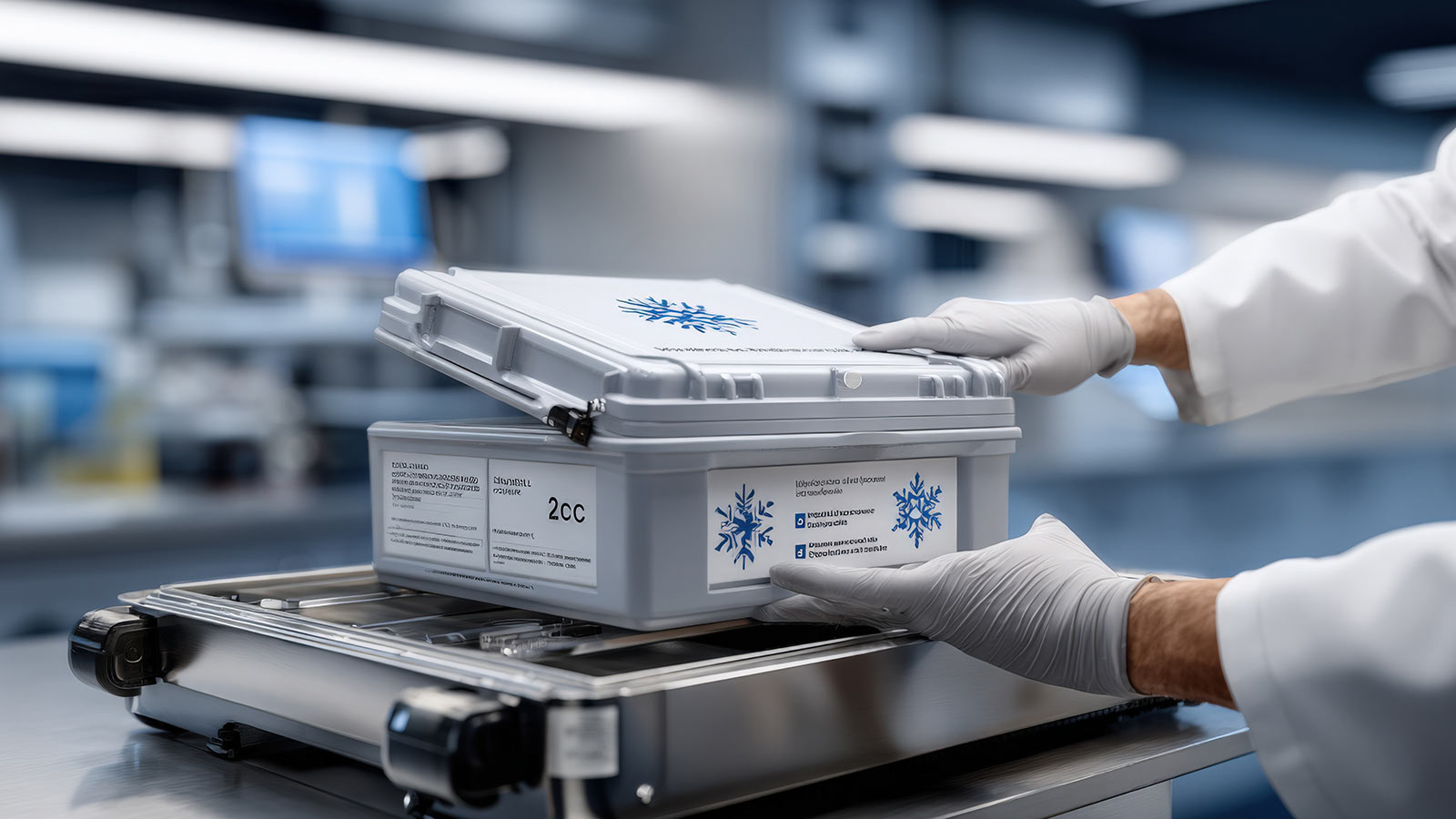
Maintaining strict temperature control is the backbone of any reliable cold-chain operation. However, traditional cooling methods, like gel packs and dry ice, provide temporary cooling solutions, but often fall short in precision, safety, and consistency, three factors that modern cold-chain logistics can’t compromise. This is where frozen phase change materials (PCMs) for cooling can be leveraged to the fullest.
What Is a Frozen PCM?
PCM cold-chain solutions are engineered materials designed to freeze and melt at precise temperatures, giving shippers and manufacturers a level of thermal predictability that traditional cooling methods simply can’t match. By holding a defined frozen set point for specific durations, these materials help maintain product integrity throughout transport. This reduces spoilage, prevents temperature-related compliance failures, and minimizes costly shipment rejections.
At their core, frozen PCMs are formulated to maintain sub-zero temperature set points, ranging from just below 0 °C down to −21 °C, depending on the sensitivity and regulatory requirements of the payload. Because they change phase at specific temperatures, they can absorb or release large amounts of latent heat, actively stabilizing the environment inside the insulated shipper.
This makes PCM cooling solutions uniquely effective at protecting frozen or ultra-cold products from temperature deviations, even when external conditions fluctuate.
Why Temperature Precision Matters in Life Sciences Packaging
Temperature-sensitive payloads, from vaccines and biologics to advanced cell and gene therapies, require rigorously controlled thermal environments to preserve stability and protect patient safety. Even short periods of warming can threaten product integrity, disrupt supply continuity, and increase regulatory and financial risk. Frozen PCM technology plays a critical role in preventing these outcomes by delivering consistent, reliable sub-zero control throughout transit.
Leveraging frozen PCMs helps organizations achieve the following:
- Payload sensitivity: Protects fragile materials such as vaccines, cell and gene therapies, biologics, enzymes, diagnostics, and reference standards that rely on precise frozen conditions to remain stable and viable.
- Impact of excursions: Prevents potency loss, failed lots, recall risk, and downstream patient impact by minimizing the chance of products drifting outside validated temperature ranges.
- Frozen use cases vs refrigerated vs CRT: Defines when frozen PCMs are uniquely required, such as for viral vectors, mRNA constructs, and long-term reference standards, to maintain strict sub-zero temperatures without the volatility or handling concerns of dry ice.
With these thermal challenges in mind, it becomes clear why frozen PCM cold chain solutions are essential for specific segments of the life science supply chain.
Frozen Temperature PCM Use Cases in Life Science Packaging

Frozen PCMs provide the most stable, predictable, and regulation-aligned method for maintaining sub-zero temperatures during transport, making them the preferred solution for highly sensitive materials that cannot tolerate thermal variability.
Their ability to hold a precise frozen set point without the volatility, sublimation, or handling risks of dry ice makes them especially effective for safeguarding the following products:
- Frozen biologics: temperature-sensitive monoclonal antibodies, recombinant proteins, and other biologic therapies that must remain frozen to preserve structure and therapeutic potency
- Pharmaceutical intermediates: in-process materials such as purified proteins, nucleic acid constructs, or concentrated drug substances awaiting final formulation
- Specialty reagents: high-value reagents like enzymes, PCR master mixes, molecular assay components, and cell-culture additives that quickly degrade when exposed to warming
- Clinical lab specimens: patient samples such as biopsies, serum, tissue sections, and genetic material that require frozen stability to maintain diagnostic accuracy
- Plasma: fresh-frozen plasma and plasma derivatives used for transfusions, research, or therapeutic manufacturing, all of which must stay within strict frozen temperature ranges
- Reagents: common laboratory and production reagents—buffers, substrates, controls, and calibrators—that lose reliability when thawed outside acceptable limits
- Vaccines: mRNA vaccines, attenuated viral vaccines, and other formulations that require frozen or ultra-cold conditions to preserve efficacy during distribution
- Biologics: biologically derived products—cell-based therapies, gene therapy vectors, blood-based therapeutics—that are extremely susceptible to thermal deviation
- Live cell cultures: cryopreserved cells, stem cell lines, microbial cultures, and other living biological systems that must remain frozen to maintain viability and functionality upon thaw
By delivering controlled, repeatable frozen performance across every leg of the cold chain, frozen temperature PCMs reduce excursion risk, preserve molecular integrity, and ensure materials arrive viable and compliant. This level of stability makes frozen PCMs the most dependable and scalable technology for transporting temperature-critical life science products.
Advantages of ThermaBrick® Refrigerant Bricks
Frozen PCMs provide reliable low-temperature stability, essential for preserving biological samples and frozen pharmaceuticals. ThermaBrick® Refrigerant Bricks featuring frozen PCMs maintain subfreezing conditions to extend product integrity and shelf life.
The brick-style form factor is a key advantage of ThermaBrick® Refrigerant Bricks, delivering consistency and reliability across every stage of a cold chain.
ThermaBrick® Refrigerant Bricks deliver these performance advantages through features such as:
- Excellent dimensional stability with minimal expansion when frozen
- Reliable thermal performance when used on passive refrigeration surfaces
- Solid-state integrity, retaining structure and fluid containment even if compromised
- Customizable sizing to meet exact shipper or system specifications
- High-efficiency thermal absorption for extended temperature control
- Non-toxic, safe materials suitable for healthcare and biotech
- Optimized internal volume, maximizing usable payload capacity
These key features enable the ThermaBrick® Refrigerant Bricks to fit seamlessly into standardized shipping workflows. The uniform geometry ensures predictable placement within the shipper and promotes even temperature distribution around the payload. This combination of engineered precision and practical usability makes ThermaBrick® a dependable foundation for frozen cold-chain performance.
Below are the available frozen PCM specifications for ThermaBrick® Refrigerant Bricks:
A Safer, Smarter Alternative to Dry Ice
For decades, dry ice has been the default solution for keeping frozen materials cold in transit. But as life science supply chains become more complex—and as safety, compliance, and predictability grow more important—dry ice is proving to be an increasingly difficult material to manage. Frozen PCMs offer a modern, safer, and more efficient alternative that aligns with today’s operational and regulatory expectations.
The Challenges of Relying on Dry Ice
Dry ice can maintain low temperatures, but it brings a long list of constraints that complicate cold-chain operations.
Safety Concerns
- Requires PPE to avoid skin burns and CO₂ exposure
- Demands additional training for safe handling and replenishment
Operational Inefficiencies
- Rapid sublimation forces constant monitoring and inventory management
- Performance varies depending on timing, environment, and packaging design
Regulatory & Compliance Burdens
- Classified as a hazardous material, adding complexity to every shipment
- Requires hazmat labels, documentation, and trained personnel
- Creates risk of fines or shipment delays if mishandled or mislabeled
Why Frozen PCM Cold Chain Solutions Are a Better Choice
Frozen PCM solutions eliminate many of the challenges associated with dry ice, offering a safer, more predictable, and far more operationally friendly solution.
Non-Hazardous Handling
- No personal protection equipment (PPE) required for packing or unpacking
- No specialized storage conditions or training needed
Consistent Thermal Performance
- Maintains precise frozen temperatures without sublimation loss
- Provides predictable, validated performance ideal for controlled cold-chain environments
Simplified Logistics
- No hazmat labels or special documentation required
- No regulatory oversight, which reduces shipping time and complexity
Cost & Efficiency Advantages
- Less labor, no dry ice replenishment, labeling, or compliance checks
- Lower regulatory risk and avoidance of hazmat-related fines
- More consistent performance, reducing product waste, temperature excursions, and reshipments
The bottom line: frozen PCMs deliver a safer, compliant, and more reliable way to transport frozen life science materials, without the volatility and burden of dry ice. As organizations seek to streamline operations and strengthen product integrity, frozen PCMs offer a level of simplicity and performance that legacy dry-ice shipping simply cannot match.
Protect Life Science Shipments with Reliable Frozen Temperature Control
ThermaBrick® Refrigerant Bricks achieve consistent, compliant frozen temperature cold-chain performance. Contact our cold-chain engineering team to select the right ThermaBrick® Refrigerant Bricks for all your life science shipping needs.